



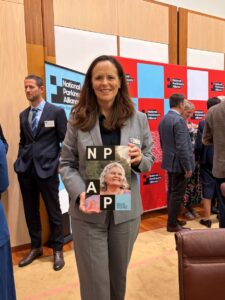
Australia’s first National Parkinson’s Action Plan has been launched, marking an important step towards a more coordinated national response to Parkinson’s disease.
Parkinson’s is the world’s fastest growing neurological disorder. More than 200,000 Australians live with Parkinson’s disease. The condition is highly prevalent and places a significant burden on individuals, families, carers and the health system.
Launched at Parliament House in Canberra on 24 March 2026, the National Parkinson’s Action Plan was developed by the National Parkinson’s Alliance with support from the Australian Federal Government. It provides a five-year framework to help address unmet needs across health, disability, aged care and research.
The Plan aims to guide government policy, strengthen research investment, and improve fair and equitable access to care and support for people living with Parkinson’s, their families and carers.
The Plan’s six priorities
The National Parkinson’s Action Plan sets out six priority areas to guide national action over the next five years:
- prevention and risk reduction;
- earlier diagnosis and intervention;
- improved data and evidence;
- workforce capability;
- fair and equitable access to care and support; and
- stronger research, innovation and translation.
A plan shaped by the Parkinson’s community
The National Parkinson’s Action Plan was informed by extensive consultation with people living with Parkinson’s, families, carers, clinicians, researchers and sector leaders. More than 5,700 people contributed through in-person and virtual consultations, phone discussions and a national survey.
Why the Plan matters
The worldwide prevalence of Parkinson’s doubled in the 25 years to 2015 and is expected to double again by 2040. While genetic causes are known, epidemiological research has also suggested links between Parkinson’s and exposure to pesticides and other toxins.
Professor Carolyn Sue, Professor of Neurology and Chair of the National Parkinson’s Alliance, said environmental and lifestyle factors may form part of the picture, but more research is needed before they can be considered established causes.
“There’s not one single factor that contributes to the whole spectrum of Parkinson’s disease,” Professor Sue said. “More research needs to be done, which is exactly what the National Parkinson’s Action Plan calls for.”
The Plan recommends tighter regulation of certain pesticides and industrial solvents linked to Parkinson’s, alongside a stronger national focus on research, prevention, diagnosis, treatment, care and support.
A coordinated national response
Richard Wylie, Executive Director of the National Parkinson’s Alliance, said Australia is already well resourced to take up the fight against Parkinson’s, but needs to mobilise.
“The Action Plan calls on the government to really back our winners and continue backing research,” Mr Wylie said.
If implemented effectively, advocates say the Plan could place Australia at the forefront of global Parkinson’s research while improving quality of life for people living with the condition.
The National Parkinson’s Alliance describes the Plan as a way to ensure people living with Parkinson’s and their families receive fair and equitable access to care and support, and benefit from strategic investment in research.