


Core strength is an important, but sometimes overlooked, part of exercise for people living with Parkinson’s. The core includes the muscles around the abdomen, back, pelvis and hips. Together, these muscles help stabilise the body, maintain posture and provide a strong foundation for movement.
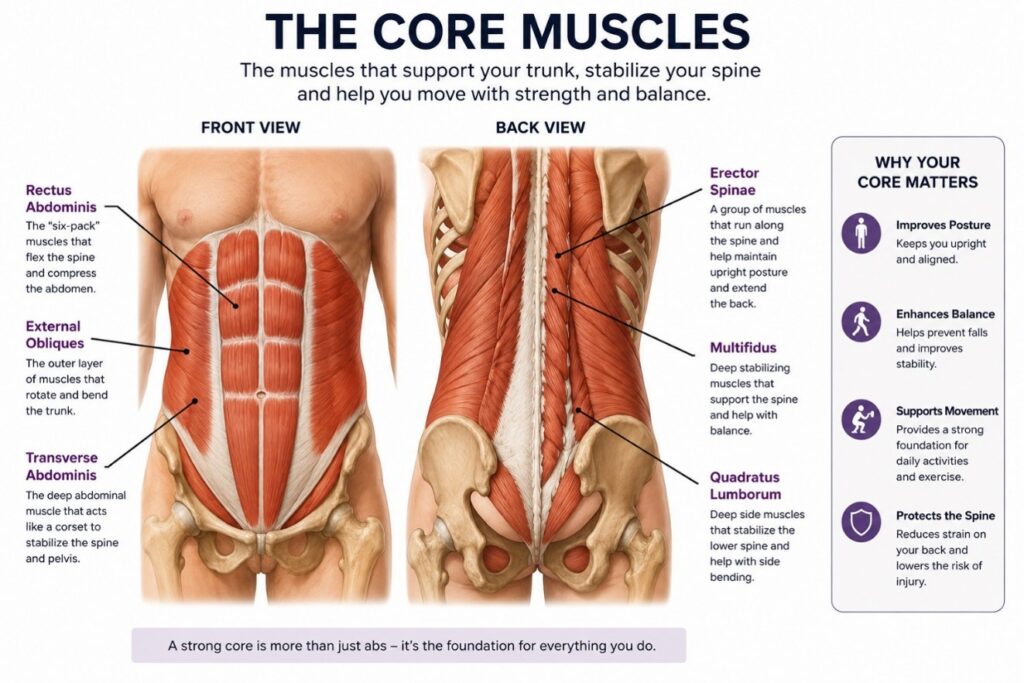
Parkinson’s can affect posture, balance, coordination and the ability to make large, controlled movements. Weakness or reduced control through the trunk can make everyday activities such as standing, walking, turning, reaching and getting in and out of a chair more difficult.
Research supports exercise as an important component of Parkinson’s management. Strength and resistance training can improve strength and functional outcomes, while balance training can improve postural control, mobility and balance. Research specifically examining trunk/core exercises also suggests potential benefits for balance, although the evidence is not yet strong enough to say that core strengthening alone will improve balance for everyone.
The goal, therefore, is not simply to develop a “strong stomach”. Good core training should help a person maintain an upright posture, control the trunk during movement and transfer strength between the upper and lower body.
Progressing Core Exercises
One of the advantages of core exercises is that the same basic movement can often be progressed through several levels. This allows an exercise program to be adapted to an individual’s current ability and gradually made more challenging.
Benefits of Using Different Exercise Positions
Using the bed, seated and standing positions provides a useful progression.
Lying down reduces the balance demands and allows the person to concentrate on activating and controlling the abdominal and pelvic muscles.
Sitting introduces greater postural demands while providing a stable base of support. It also allows trunk rotation and reaching to be incorporated.
Standing requires the core to work together with the legs and hips to maintain posture and balance while the body moves.
This progression can make core training more accessible to people with different abilities and can provide a pathway from simple exercises towards more functional movements.
Core Strength and Functional Movement
For someone with Parkinson’s, core training should ultimately support function rather than simply muscle strength. Being able to control the trunk can contribute to movements such as rising from a chair, turning, reaching, walking and maintaining an upright posture.
The important principle is progressive challenge. An exercise does not necessarily need to become dramatically harder. Progression can come from increasing the range of movement, reducing support, adding repetitions, slowing the movement, increasing resistance or combining movements.
A Word About Safety
People experiencing significant balance problems, dizziness, freezing, falls, pain or difficulty getting safely into or out of a position should seek advice from a physiotherapist or other appropriately qualified health professional experienced with Parkinson’s.
The aim is not to exercise at the hardest level possible. The aim is to find the appropriate level; practise it well and gradually progress when the movement can be performed safely and confidently.
References
- American Physical Therapy Association. Physical Therapist Management of Parkinson Disease: A Clinical Practice Guideline. Physical Therapy.
- Parkinson’s Foundation & American College of Sports Medicine. Parkinson’s Disease Exercise Recommendations.
- García et al. Efficacy of Specific Trunk Exercises in the Balance Dysfunction of Patients with Parkinson’s Disease: A Systematic Review and Meta-Analysis. International Journal of Environmental Research and Public Health.
- Shu et al. Physical exercise for people with Parkinson’s disease: a systematic review and network meta-analysis. Cochrane Database/Systematic Review literature.
- Parkinson’s disease in adults: diagnosis and management.