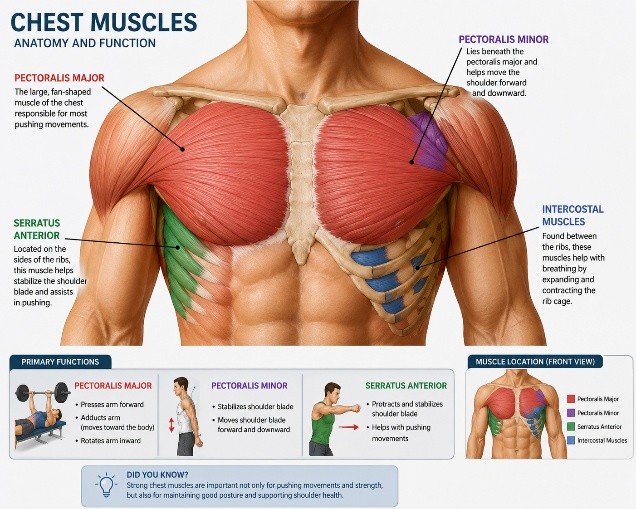

The chest press is one of the most effective upper body strengthening exercises for people living with Parkinson’s disease. It strengthens the muscles used every day for pushing, reaching, getting out of bed, standing up from the floor, and maintaining an upright posture.
Like all exercises, the chest press can be adapted to suit your current ability. Starting at the right level and progressing gradually helps improve strength safely while reducing the risk of injury or excessive fatigue.
Important: good technique is always more important than lifting heavy weights.
Level 1 – Body Weight Chest Press
Wall Push-Up
Stand facing a wall with your hands shoulder-width apart. Slowly bend your elbows to bring your chest towards the wall before pushing back to the starting position.
Benefits
- Ideal for beginners
- Improves pushing strength
- Develops shoulder stability
- Encourages good posture
- Minimal stress on the joints
- Excellent for people with reduced balance
Progression (make a bit harder)
Move your feet further away from the wall to increase the challenge.
Bed Push-Up
While sitting on the edge of a firm bed, place your hands beside your hips and gently push through your arms to lift some of your body weight.
Benefits
- Helps strengthen the arms and chest
- Assists with bed mobility
- Makes transferring easier
- Suitable for people with limited standing ability
Progression (make a bit harder)
Move your feet further away from the bed to increase the challenge.
Floor Push-Up (Modified)
On your floor on your hands under your shoulders and knee under your hips, perform a push-up by bending and straightening your elbows. Alternatively, from your knees, drop your hips, keeping your body in a straight line between knees and shoulders, and perform a push-up.
Benefits
- Increases upper body strength
- Activates the core muscles
- Improves shoulder control
Progression
Perform a full push-up from your toes as strength improves.
Level 2 – Resistance Bands
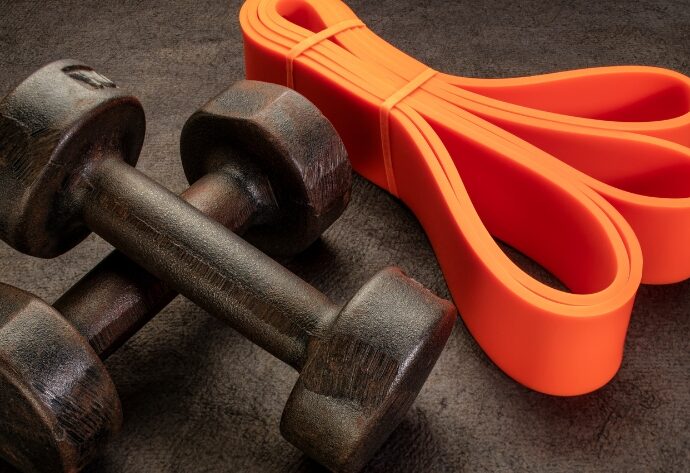
Resistance bands provide gentle, adjustable resistance and are excellent for people beginning strength training.
Standing Chest Press
Anchor a resistance band behind you and press your hands forward until your arms are straight before returning slowly.
Benefits
- Improves chest and arm strength
- Challenges posture
- Activates core muscles
- Allows smooth, controlled movement
Progression
- Increase band resistance – (come in a variety of tensions)
- Increase repetitions.
- Perform one arm at a time.
- Perform in a split stance. (One foot in front of the other. Use both feet)
Level 3 – Dumbbells
Floor Chest Press
Lie on the floor with knees bent and hold a dumbbell in each hand. Press the weights towards the ceiling before lowering until your upper arms gently touch the floor.
Benefits
- Improves chest, shoulder and arm strength
- Limits shoulder movement, making it comfortable for many people
- Encourages equal use of both arms
Progression
Gradually increase the weight while maintaining good control.
Bench Chest Press
Perform the same movement while lying on a flat exercise bench.
Because the bench allows a greater range of movement, the muscles work a little harder than during a floor press.
Benefits
- Greater muscle strengthening
- Improved shoulder stability
- Increased functional pushing strength
Progression
Gradually increase the weight while maintaining good control.
Level 4 – Weight Machines
A chest press machine provides guided movement, and extra safety making it an excellent option for many people with Parkinson’s.
Benefits
- Safe and controlled movement
- Easy to adjust resistance
- Less balance required
- Builds confidence
- Suitable for progressive strength training
Progression
Gradually increase the weight while maintaining good control.
Choose a weight that feels challenging during the final two or three repetitions while still allowing good technique.
Level 5 – Barbell Bench Press
This is generally appropriate only for people who already have good upper body strength, shoulder mobility, and exercise experience.
A spotter should always be present.
Benefits
- Builds maximal strength
- Improves muscular endurance
- Develops whole upper body coordination
This level is not necessary for everyone. Excellent functional strength can be achieved using dumbbells, resistance bands, or machines.
How to Progress Safely
Before increasing the weight, make sure you can:
✓ Complete all repetitions with good technique.
✓ Move through the full range of motion without pain.
✓ Maintain steady breathing.
✓ Control the movement both up and down.
When these become easy, increase only one of the following:
- Weight
- Number of repetitions
- Number of sets
- Range of movement (shallow/deep/wide/narrow)
- Exercise difficulty
Avoid increasing several variables at the same time.
Why Chest Press Exercises Matter for People with Parkinson’s
Regular chest strengthening can help improve:
- Posture
- Arm strength
- Bed mobility
- Pushing open doors
- Getting up from the floor
- Transfers in and out of chairs
- Carrying groceries
- Confidence during daily activities
Combined with rowing exercises, mobility exercises and stretching, the chest press also helps maintain balanced upper body strength and reduce the rounded shoulder posture that commonly develops in Parkinson’s disease. Progression, levels and benefits with other exercises to follow.
Safety Tips
- Exercise when your Parkinson’s medication is working well (‘on’ time), if possible.
- Avoid holding your breath while lifting.
- Move slowly and with control.
- Stop if you experience chest pain, dizziness, or unusual shortness of breath.
- If you have balance difficulties, perform standing exercises near a stable support or choose seated or lying variations.
- If you are new to resistance training, seek guidance from a physiotherapist or accredited exercise physiologist with experience in Parkinson’s.
Important
The goal of the chest press is not to lift the heaviest weight possible. It is to build strength that improves everyday life. Whether you begin with a wall push-up or progress to lifting weights on a bench, each level provides valuable benefits. By choosing the right starting point and progressing gradually, you can safely improve strength, posture, confidence and independence.
References
- American College of Sports Medicine. (2021). ACSM’s guidelines for exercise testing and prescription (11th ed.). Wolters Kluwer.
- Exercise & Sports Science Australia. (2019). ESSA position statement on exercise for people with chronic conditions. Exercise & Sports Science Australia.
- Ellis, Terry, & Rochester, Lynn. (2018). Mobilizing Parkinson’s disease: The future of exercise. Journal of Parkinson’s Disease, 8(s1), S95–S100. https://doi.org/10.3233/JPD-181489
- Keus, Sebastiaan H. J., Munneke, Marten, Graziano, Maria, et al. (2014). European Physiotherapy Guideline for Parkinson’s Disease. KNGF/ParkinsonNet.
- Parkinson’s Foundation. (2021). Exercise and Parkinson’s. The Parkinson’s Foundation.
- Schenkman, Marjorie, Hall, Deborah, Kumar, Rajesh, & Kohrt, Wendy M.. (2012). Endurance exercise training to improve economy of movement in people with Parkinson disease. Archives of Physical Medicine and Rehabilitation, 93(9), 1494–1502. https://doi.org/10.1016/j.apmr.2012.03.009
- World Health Organization. (2020). WHO guidelines on physical activity and sedentary behaviour. World Health Organization.
- Corcos, Daniel M., Robichaud, Julie A., et al. (2013). A two-year randomized controlled trial of progressive resistance exercise for Parkinson’s disease. Movement Disorders, 28(9), 1230–1240. https://doi.org/10.1002/mds.25380
- Goodwin, Virginia A., Richards, Sarah H., Taylor, Rod S., Taylor, Adrian H., & Campbell, John L.. (2008). The effectiveness of exercise interventions for people with Parkinson’s disease: A systematic review and meta-analysis. Movement Disorders, 23(5), 631–640. https://doi.org/10.1002/mds.21922