

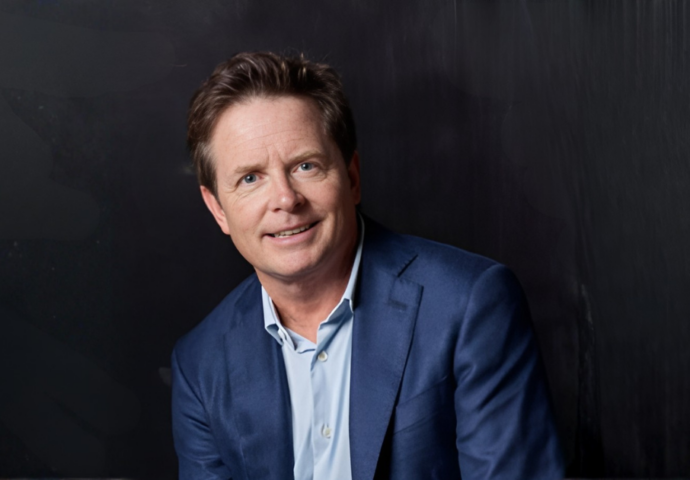
When Michael J. Fox was diagnosed with Parkinson’s disease at age 29 in 1991, “…it was an old person’s disease,” he says. “It was not a disease that got much attention.”
But now that it was his disease to deal with for the rest of his life, Fox got busy learning everything he could about the state of scientific progress and the realities of living with Parkinson’s. He quickly saw what was missing – and what he could help provide.
“I was motivated by what I heard from the science people who said that the science is ahead of the money,” says Fox. “They said, ‘If you can direct money toward the right research, we can speed things along.’ And then I was touched and motivated by the patient community. They just needed someone to step in and push things along.”
Fox co-created the Michael J. Fox Foundation for Parkinson’s Research with Deborah Brooks, formerly of Goldman Sachs, in 2000 essentially “to be a noodge; I wanted to push things along,” he says.
He went where the money is – to businesses and hedge funds – and appealed to the “ego side of them, to the winners who wanted to win, and I said, ‘Let’s win [against this disease].’” He brought with him his trademark charm. Fox’s philosophy: “I’ll come in your office, I’ll take pictures with all of your employees, and I’ll pound you for money,” he says.
Key role
The organisation’s key role, more than 25 years later, is to convene scientists, policy makers, and advocates to address barriers standing in the way of better understanding Parkinson’s and developing new treatments – and ultimately a cure.
“Our goal was to put ourselves and the capital we would raise into the perspective of the patients: what are their unmet needs, and what could be done?” says Brooks, who oversees the foundation’s fundraising and marketing efforts. “What we saw at that time was not much in the way of novel targets for drug development. And I think today there are 175-plus therapeutic interventions being tested in humans.”
Since its creation, Fox and Brooks have built the foundation from a startup into the largest non-profit funder of Parkinson’s research, surpassing even the U.S. government, with more than $2 billion provided to scientists to date.
One of the projects the foundation supports is to find ways to identify and track the progression of Parkinson’s, a critical step toward identifying patients early and allowing doctors to monitor the progression of the disease and the effectiveness of new treatments.
The Parkinson’s Progression Markers Initiative is a study involving scientists from around the world to identify the key biological signals of the disease; since its launch in 2010, the study has tripled the number of Parkinson’s patients enrolled and led to a breakthrough test of spinal fluid for a key abnormal protein of the disease, years before the first symptoms appear.
Way to diagnose the disease
The test provides a scientifically validated way to diagnose the disease, improving on the symptoms-based criteria on which doctors had previously relied.
Sharing his diagnosis, as well as being open about how it was affecting him, wasn’t an easy choice, Fox says. It took about seven years after his diagnosis to disclose it publicly, but once he did, he saw the impact.
“I went online and into Parkinson’s chat rooms, and I would go in anonymously, and would ask, ‘What do you think of this Michael Fox thing?’ And they would say, ‘It’s great.’ I would think, ‘You’re celebrating my having Parkinson’s.’ But then I got it, and realised these people were stuck in the rocking chair on the porch for all this time to just whittle away until they can’t move, and never had a part in solving their problems.”
“The more I thought about it, the more I thought it was a privilege, and in a way, a gift,” he says. “It’s a gift that keeps on taking, but if I look at the positive side of it… this is a role that I fell into and I found myself uniquely qualified to fulfil. Now people say, ‘I have what Michael Fox has.’ Parkinson’s patients now have an identity, and they don’t have shame.”
Fox says advances in genetics and the progress in identifying biological markers of Parkinson’s are only the beginning. “I know we’ve done a lot, but we haven’t cured Parkinson’s,” he says. “I’m always pushing and never happy until we get this done. We’ve changed the way people think about the disease, and we know there’s an end, and we’ll find it.”
That requires continuing to build on what the foundation has started so that promising treatments can come to fruition. “I was always a small guy; I was bullied and pushed around, and I would overcome that and push through it. [Parkinson’s] is the biggest bully there is for me. And I’m not just going to let it get its way. We’re going to have a fight and I’m going to get a few punches in. I may get beat up in the long run, but we’ll get it done. I’m a – pardon my language – tough son of a bitch and I’m going to get it done.”
Ultimately, he says, “I’d like to see a world without Parkinson’s, and I think that will happen. I think in 30, 40 years, this will be done. Optimism is a powerful thing.”
Source:
Original article by Alice Park, Senior Correspondent, TIME Magazine